
The Journey of the Wood
Every note a Riento guitar plays belongs to a story that begins in a living forest and continues with one still standing.

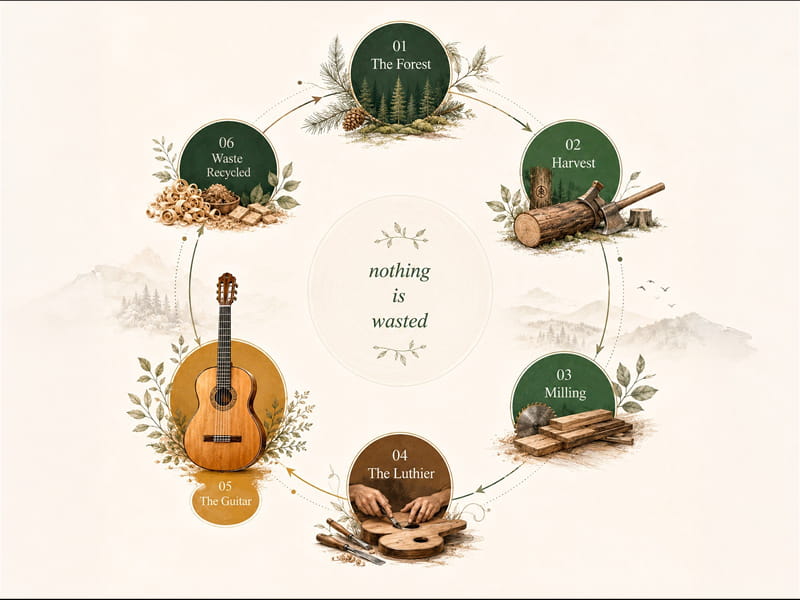
The Complete Cycle
Guitar making is one of the most material-conscious crafts in music. It begins with wood: a living material that takes decades, sometimes centuries, to become ready for an instrument.
At Riento, we believe that taking from living systems comes with responsibility. Responsibility for how the wood is sourced. Responsibility for how it is used. And responsibility for what is left behind.
This is the journey of the wood.

Step 01: Forest
A guitar begins in a living forest, long before a single tool is lifted.
Spruce for the soundboard. Cedar, rosewood, mahogany and other tonewoods, each chosen for the voice it carries and the resonance it holds. Every species has its own character. Every piece of wood has its own future.
We work with suppliers who share our patience. Forests should be managed, not mined. Trees should be selected with care, not treated as anonymous raw material. Because the quality of the wood shapes the quality of the instrument — and a guitar will always reveal how carefully its materials were chosen.
Our partners are expected to meet the same standards of responsibility that we ask of ourselves

Step 02: Harvest
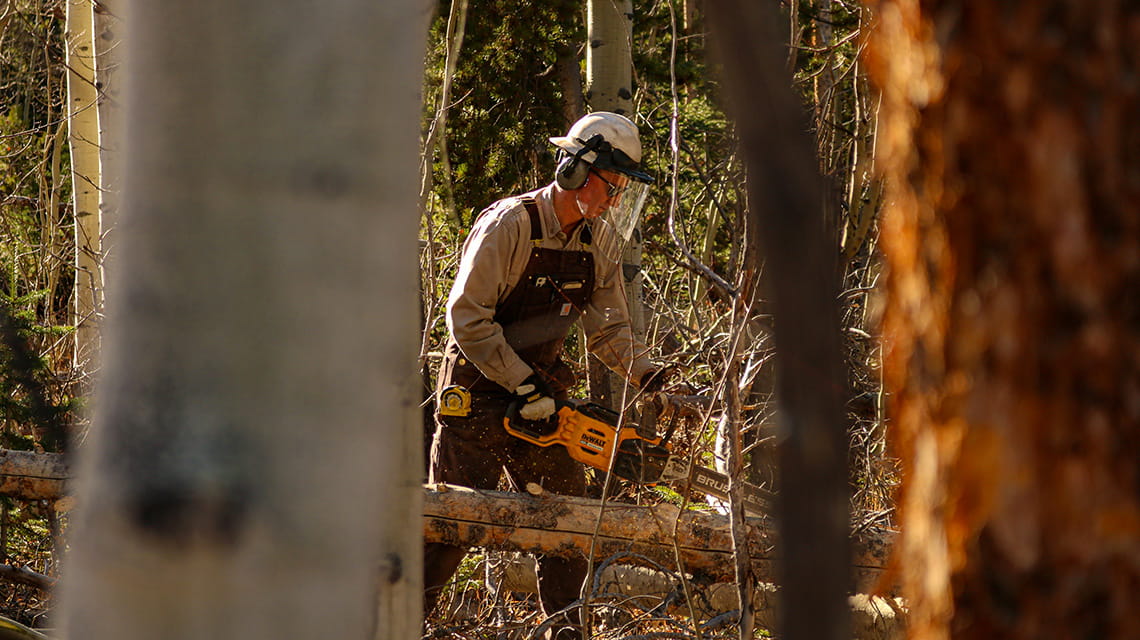
Sustainable forestry is not just a certification on a wall. It is a practice.
Selective harvesting. Replanting. Long rotation cycles. Traceable timber. Time for the forest to recover between what is taken and what is allowed to grow.
We work only with suppliers who can trace their timber back to responsible sources. When wood is taken with care, the forest is not emptied. It remains alive, managed and growing for the future.
Step 03: Milling
Once harvested, the timber begins its transformation.
For guitar making, wood is not simply cut. It is read. The grain, density, direction and stability of each piece determine what it can become. Soundboards may be quarter-sawn and bookmatched to bring out tonal clarity, balance and long-term strength.
These careful cuts take more time. They can also create more offcuts. That is a trade we accept, because the goal is not to use wood quickly. The goal is to use it well.
Offcuts are not treated as waste. Smaller pieces can become bracing, inlays, repairs or details for future instruments. Larger domestic scraps can be used as workshop fuel. Everything that can be used is given a purpose.
Material efficiency is part of the craft, not an afterthought.

Step 04: The Luthier
The story behind Riento guitars roots to the year 1977, when the Liikanen brothers began a journey that would define Finnish classical guitar making.
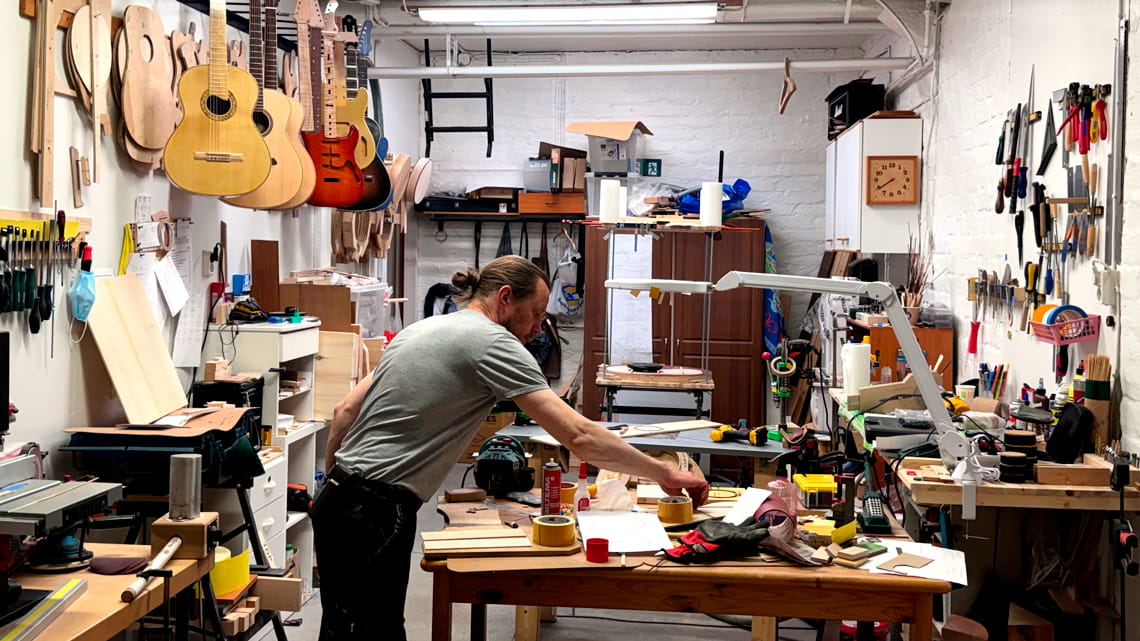
In our Finnish workshop, luthiers work with the Lens Resonance System, a technique developed in Finland to refine each guitar's acoustic response by hand. This is where material becomes music: through touch, patience and thousands of small decisions that cannot be automated.
European manufacturing also keeps the journey shorter and more transparent. It means working under EU labour protections, with regulated working conditions, legal rights and standards that are part of the manufacturing environment, not just promises made from a distance.
Step 05: The Guitar
When the finished guitar reaches your hands, its journey has been shorter and more traceable than many comparable instruments made far from their final players.
A shorter supply chain means we can stand behind more of the process: from the forest, to the mill, to the workshop, to the musician. It gives us a clearer understanding of where the materials come from, how they have been handled and who has shaped them along the way.
When you play a Riento, you play an instrument with a known origin. The wood has a history. The hands have names. The route is short enough to understand.
That knowledge changes what it means to make music.

Step 06: The Return
The cycle does not end when the guitar leaves the workshop.
Offcuts are repurposed, composted where possible or used as fuel. Materials are sorted with care. Waste streams are reviewed so that each year, the process can become more efficient than before.
And the forests our wood comes from? They are still there. Still managed. Still growing. Still becoming the source of future instruments for players not yet born.
The cycle does not close when you receive the guitar.
It continues.

A Choice That Carries Forward
When you choose a Riento guitar, you choose more than an instrument.
You support shorter supply chains, European craftsmanship, responsible sourcing and forests that are meant to remain standing for generations to come.
The guitar is the instrument.
The choice is yours.